
I am not Catholic; I attend a Protestant church. I read the Westminster Confession of Faith rather than the Catechism of the Catholic Church as a statement of what I think I believe. Yet I find it hard not to be drawn to, among other things, the history and constancy, even majesty, of the Catholic Church. I read and admire the works of Catholic theologians, writers, and thinkers. I believe I disagree on some points of doctrine, but my view of how much this matters has seen considerable decline. After this life, I expect we will discover many things, including (A) all our theologies were variously wrong in important ways, and (B) God was working to advance his kingdom through many groups in this world, all of them collaborating to an extent none were able to perceive. Based on these expectations, I feel certain there are many in this world who know God better than I do, and who practice that knowledge within creeds different than mine. In fact, see the words of Jesus on this point in Mark 9:40 and John 17:20-21.
All of this is throat-clearing in prelude to say: There are simple, foundational, daily aspects of the Catholic understanding and practice of faith that Protestants could have, but have largely lost, to their detriment. There are more examples of what I mean than the three I am about to list. But each of the following items is a simple part of the wealth of practicing Catholics that Protestants are poorer, it seems to me, for having let go of.
Here they are:
1. The Sign of the Cross
In making the sign of the cross, a Christian gently traces with fingertips the way a cross’s shape is embedded within the very shape of his or her body. It is a way of matching our mind’s appeal to God with a physical appeal from our very bodies, confessing with our bodies that we belong to God, and are made by God with the very deepest and most profound sign of God’s love written into our form. These bodies are marked by the grace of God, and with the movement of a hand we can touch and trace grace’s mark.
And with the sign of the cross, the Christian also affirms the Trinity. We note as we make the sign God’s three persons: Father, Son, and Holy Spirit, followed by the only fitting response the human being can give: Amen.
This affirmation itself is revealing. Within the broad theological territory Catholics and Protestants hold in common, belief in the Trinity is at or near the core. There is no affirmation of the Trinity a Catholic Christian might give to which a Protestant Christian would not also give assent. I point this out to say: There is no reason why a Protestant might not also practice the sign of the cross.
The sign dates back far before any notion of a Christian parting between Protestant and Catholic. Something like the sign of the cross was common as far back in time as the 200s, and the sign of the cross as we understand it today seems to have appeared in the 400s, more than 1,000 years before Protestant churches’ beginnings. Christians all could reasonably accept the sign of the cross as a part of our heritage.
The distinction I am drawing here has exceptions. Some Protestant denominations do accept the sign of the cross. But even many of these do not use the sign regularly or lead members in doing so. It is Catholicism that has kept hold of the sign through routine practice, to the point the sign feels almost entirely as though it belongs to this group. I make this sign, I pray with my body in this way, and to do so is to have the feel of borrowing something from a people who, fortunately, I am confident would gladly welcome seeing its practice more widely used.
2. Sainthood
All Christians speak of “saints,” but not necessarily in the same way. The Bible’s use makes clear by implication that all of us who believe are saints (Acts 9:13, among many other examples) and the Catechism of the Catholic Church recognizes this sense of the word as well (CCC paragraph 1475, for example). But the Catholic Church also employs the other definition of “saint,” the one I believe most of us, Catholic or otherwise, tend to feel when we hear this word. That is, “saint” as an exemplar of holiness, saint as a man or woman low enough in his or her submission before God that she or he has now been lifted high in loving authority across God’s kingdom.
We Protestants are poorer for not holding to this aspirational sense of the word “saint,” this sense of a state of holiness few of us earthly saints know today, but that we can attain through humble submission to the Lord working in us that humans before us have shown. Because of the aspirational meaning of the word “saint,” Catholic philosophy professor Peter Kreeft (in this book) is able to express the human purpose and mission this plainly: “The meaning of life is to be a saint.”
Perhaps we Protestants believe we cannot mention saints, or ascribe to the second definition of saint, because this then inevitably leads to the questions of what the eternal saints do today and how we should respond to them—do we pray to them? Do their relics have power? And so on. Maybe.
What I find myself missing in this, in not thinking of the exemplary saints, is the very sense of an example. There is a sort of loneliness in not seeing or looking to such saints. I am going somewhere with this faith, or I ought to be. There is a way ahead, a way of the Spirit. And to be sure, the Spirit is with me in every step. The way is hard, and I get waylaid and confused, and yet, importantly, other human beings have gone this way. It is the direction of joy and purpose, along with pain, and it is not abstract—the way is real, with human saints ahead of us to light the path.
3. Belonging
This third item in the treasure chest of Catholic wealth is the gift it gives even to those who reject or refuse other riches of the faith. To one baptized and confirmed as Catholic, the statement, “I am Catholic,” remains true and valid as an expression of identity even if no practice or belief of the faith holds any current sway. Human beings want this even when they scoff at it. They want to belong, and Catholicism offers sufficient strength and definiteness to give people this belonging. To the extent that, if one ever turns back toward this faith, they know what the faith is that has never turned away from them, that has held them all along.
The statement, “I am Protestant,” certainly cannot offer that same belonging. “Protestant” is an umbrella category covering denominations and independent churches. In the past, I get the sense that a denominational affinity might have offered something like this belonging. “I am Methodist” might once have told people something about the speaker and told the speaker something about himself in a way the statement does not seem to today. I do not know; so much has changed about American Christian practice that the feel of, say, mid-twentieth-century Christianity, which was before my time, is hard to piece together clearly.
It is ok—this wealth is not as lost as it seems. My hope, and indeed my confident belief, is that “Christian” still does, and always will, offer something like this same belonging. Not with the majesty, definiteness, structure, and form that belonging to the Catholic Church suggests. But for the one who once had easy contact with the Christian faith, even long ago, even as a child, the sense of possessing it and having a claim to it remain, such that “I am a Christian” is the statement of belonging this person might yet say, with full confidence in the truth and power of the declaration.
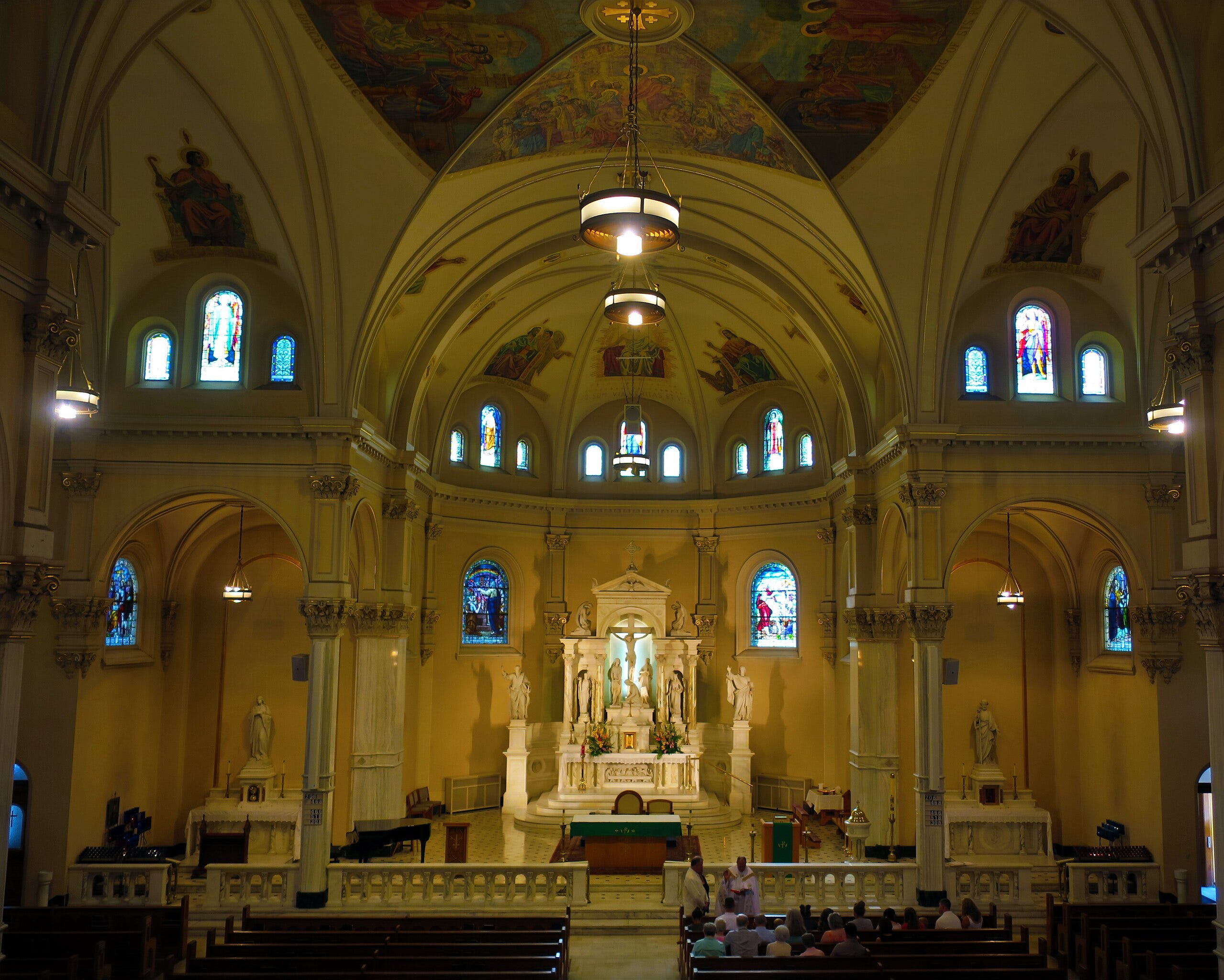
Photo: Saint Peter's Church (Mansfield, Ohio) - nave, view from the loft in 2017 by Nheyob, CC BY-SA 4.0, via Wikimedia Commons