
The writer experiencing a dormancy, listlessness, or lack of inspiration in his writing might naturally look to writing about that dormancy itself as a way of finding and producing the next piece. That is, write about not writing. It’s what he’s got.
By “dormancy,” in this case, I mean something less like the opposite of activity, and more like the opposite of fecundity. Imagine a field that is barren when it ought to be bountiful with crops (ideas) for the writer to harvest.
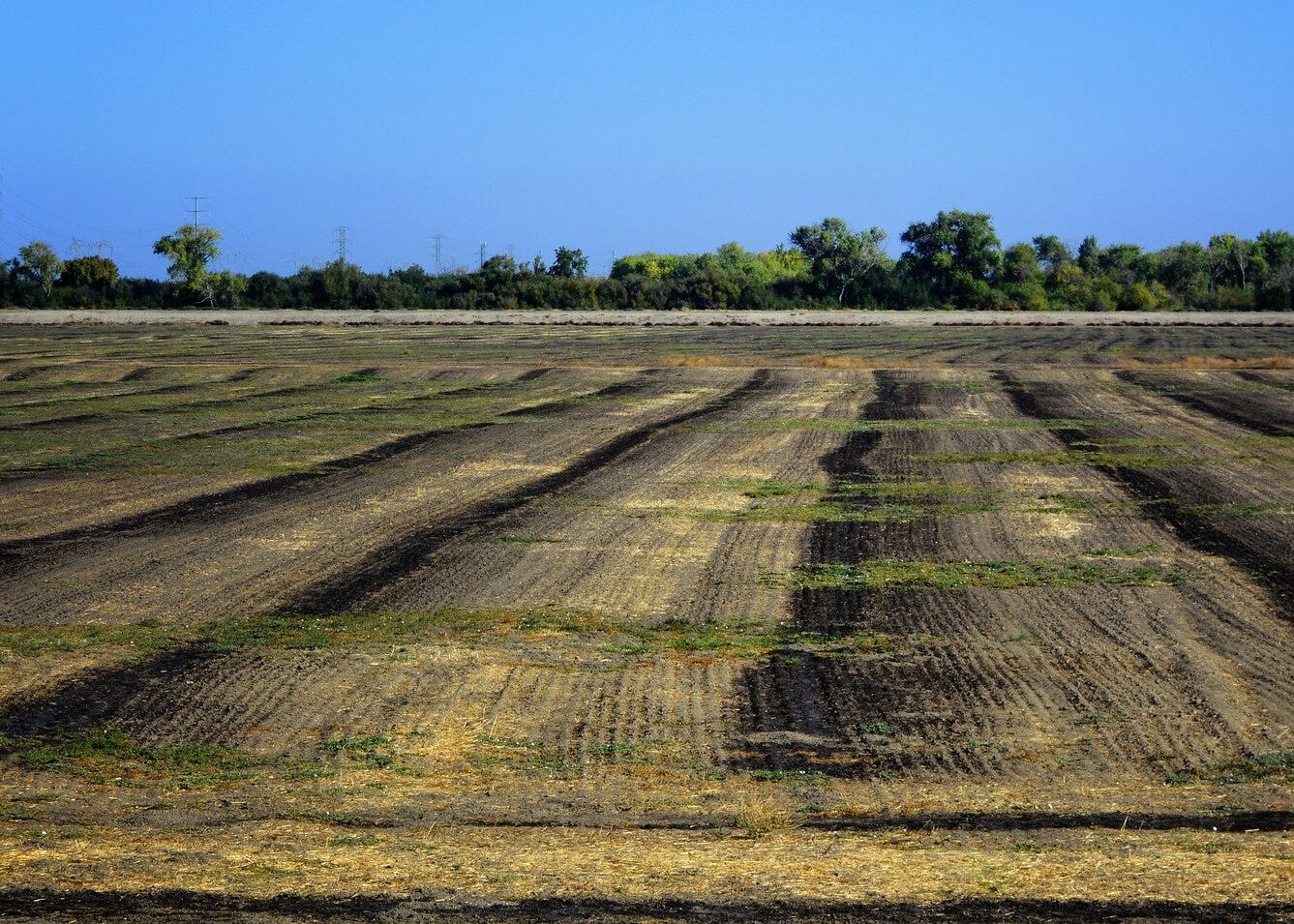
But this very picture, this way of seeing the fact of the writer not writing, already frames the predicament a particular way. I could have spoken instead of “writer’s block,” but I did not. Is “block” the right word, as in a barrier that the writer might power through with greater effort or strength? I do not know. Octavia Butler (a writer I love) considered writer’s block to be the right term and suffered from it in her writing. I have used “dormancy” because it leaves me more options for interpreting the nature of not writing, more choices for how I might consider the condition.
So why is the dormant field not producing? Why are the ideas not coming? Meaning: Why am I not experiencing ideas of sufficient import, ideas so full of interest that they inspire me to the work (strange and difficult work) of developing them into paragraphs to share with you?
To turn to a different analogy, why is the muse not speaking?
Following are two ways to understand the dormant creative fields. They offer two ways to view what the writer has or has not done, and therefore two ways to view what I ought to do next.
1. Failure
One view is this: The dormancy is an outcome of failing or failure. I have been poisoning the field, and I need to stop.
To write, I do not need just ideas. I also need optimism. Presumably, the ideas worthy of writing are everywhere; there is plenty of seed to be sown in the field. But the field needs sufficiently rich and healthy soil for the seed to grow. A field might be dormant due to neglect or mistreatment of that soil. The muse might be silent due to similar disregard. My dormancy, my lack of finding inspiration, is because I do not have the fertile soil of optimism, of joy, by which to germinate the ideas that fall to me.
How then to stop poisoning the soil? What is the toxin that has gotten into the soil, the opposite of joy? The first answer might be “sadness,” but this can’t be right. Sadness, which makes the mind lonely so that the muse is the only company, might lead to writing.
The opposite of joy I see as more apt to be the toxin is fear. I have been harboring fear, and my creative soil has soaked up too much of it. Creativity is, among other things, an outflow of courage. A writer cannot write unless she believes she can wield her gifts to fully express her idea, to see it all the way through. But the reserve of courage is finite, and fear—the fear of anything that might be going on—saps the reserve until there is too little left. My own fields might be ailing because of any fear I have allowed to overflow, perhaps the fear that produces busyness (my to-do list is long and I must race harder to obey it) or the fear that produces worry (a great threat is before me and I must rehearse it again and again). To end the dormancy, either I must rest from fear, or—returning to the “block” analogy—I must overcome it or break through.
2. Fallowness
But another view is this: The dormancy is cyclical. It just happens. I need to wait through it for the next season of growth to come.
Rather than a failure or interruption of the process, then, dormancy might be fully part of the process: an idleness necessary to inspiration, as unsatisfying as this might be. I think of a scene in a science fiction novel in which earth is sending a message in long, slow, binary on/off signals like Morse code to an alien civilization living far away at a faster rate of time. (The book I am remembering might be Dragon’s Egg by Robert Forward.) The technician sending the message, who feels like he is doing nothing during the long “off” periods, has to be reminded that each of these off interludes is needed for the message to make sense. Similarly, creativity might require periods of dormancy, whether for the rest and the refilling of energy, of for the sake of a new dawn, a new experience of newness essential for creative discovery.
The image I have suggested of a barren field in fact suggests this explanation. Fields that are farmed are periodically left fallow as part of the farming. The fields are plowed but not seeded, allowing a season for the soil to recover.
Before writing this piece, I cleared my drawer of all the partial or incomplete longhand drafts that I am done with, and I began a new list of the seeds of ideas that might lead to new drafts and therefore posts for this site. In this second way of seeing and understanding my lack of inspiration to write, my role is just to wait and to trust for the inspiration to return.
Photo: “Fallow Field” by Eric Sonstroem