
The culmination and the final scene of the sweeping first book of the Bible, the 50-chapter book of Genesis, is an act of forgiveness among brothers.
This little passage, a few sentences out of a text written 3,500 years ago, still says practically everything we need to know about how and why human beings can forgive, and what it means to forgive.
Here is the context: Joseph’s brothers, the children of Jacob and great-grandchildren of Abraham, all got together to sell Joseph into slavery as a child. They did this because they envied him and hated him. They told Jacob, their father, that his treasured son Joseph had died. Joseph did not die, but he was taken away.
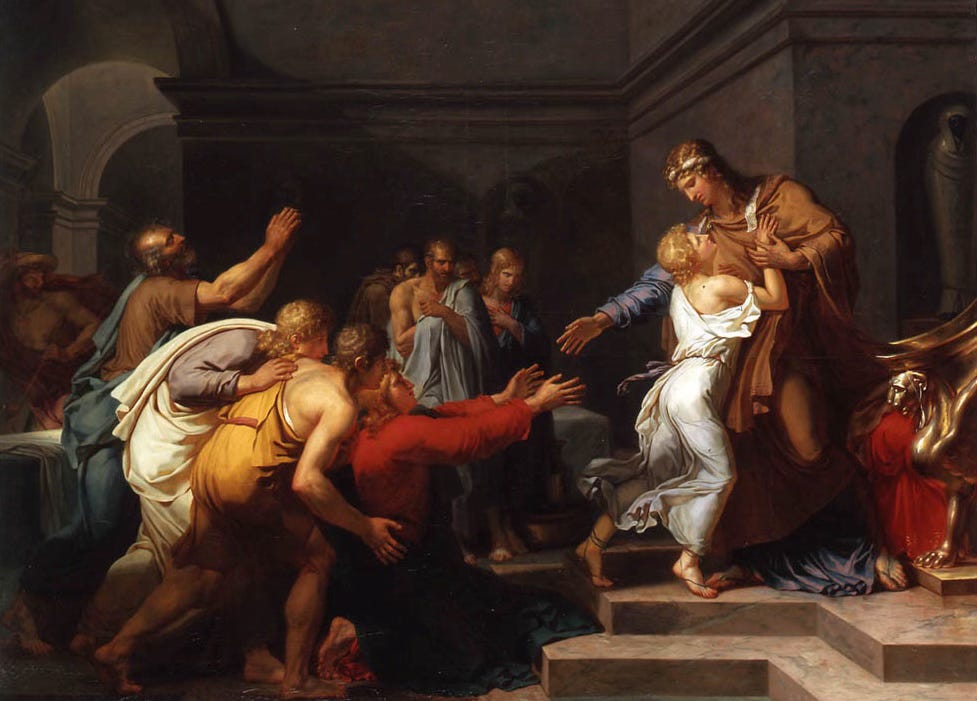
To compress and summarize a life story that then goes on to account for much of the book of Genesis, Joseph suffered and was imprisoned. But he was also discovered to have a rare talent, and ultimately he became an agent of the ruler of Egypt. In this role, during a time of famine, Joseph acquired land from subjects who otherwise would have no way to buy food. He acquired in this way the land of his brothers, now much older, who discovered all these years later that it was Joseph ruling over them, that Joseph was back in their lives and now they were subject to him.
Here is the passage that comes next, describing the reunion among these brothers. I have kept the verse numbers in because I will refer to them below:
(18) Then his brothers also came to him, bowed down before him, and said, “We are your slaves!” (19) But Joseph said to them, “Don’t be afraid. Am I in the place of God? (20) You planned evil against me; God planned it for good to bring about the present result—the survival of many people. (21) Therefore, don’t be afraid. I will take care of you and your little ones.” —Genesis 50:18-21
As I say, this passage contains practically everything we need to know about how and why human beings can forgive, and what forgiveness means. To see this, go line by line.
1. God Decides the Judgment (v19)
“Vengeance is mine,” God states elsewhere in scripture (Deuteronomy 32:35). Vengeance belongs to God. Meaning: No matter how much I might want it, vengeance does not belong to me. Vengeance is not mine. Nor was it Joseph’s.
In Genesis 50:19, Joseph expresses this point. His brothers fear he will inflict retribution upon them, which he has the power to do, and which the brothers arguably deserve. But Joseph instead says he is not the one they need to fear.
“Am I in the place of God?” he asks in verse 19. (Answer: No.)
This same principle applies to every power of vengeance that we possess, including the power to slander another or even to rage against a villain in our thoughts. To determine the measure of pain or wrath another person deserves to feel is to take the prerogative of God and stand in the place of God. Needless to say: Big shoes to fill. Joseph rejected vengeance because he rejected claiming God’s role and authority.
2. Forgiveness Is Not Dismissal (v20)
“You planned evil against me,” says Joseph (Genesis 50:20a). This is unquestionably true. Forgiveness does not discount evil nor take it away. Real forgiveness is not denial. Forgiveness is not a whitewashing, and it is surely not the equivalent of “whatever” or NBD. We discredit forgiveness and the people it affects by treating or presenting forgiveness this way.
Real forgiveness is instead nearly the opposite—it is an acceptance of the cost of the evil. Joseph accepted the price of what had been done to him without demanding repayment in the form of suffering by his brothers. By forgiving, Joseph paid the debt himself.
No one in history demonstrates this more fully than God himself through Jesus Christ. One may now have forgiveness for sin, which is the rejection of God. One may now may have forgiveness for elevating idols in God’s place. For each of us, this forgiveness is a gift. But for Jesus, there was a price to be paid. That price is real because the forgiveness is real. Far from denial, forgiveness involves seeing and accepting the undeserved debt.
3. Evil Is Too Small to Stop God’s Plans (v20)
Every event that happens is a thread with which God is weaving. There is no thread that the tiny acts of humans or the petty machinations of Satan can remove from God’s tapestry. Paul wrote about this in the New Testament:
God works all things together for good with those who love him, who are called according to his purpose. —Romans 8:28
Again, what the brothers did was evil. Again, there is no changing this or turning from this. And yet.
And yet God meant it for good (Genesis 50:20b). That act of evil put Joseph in a position in which he could save a nation and its people from famine.
God reveals through the unfolding of events how he coopts evil acts so that even these acts work into his plan for good, advancing his aim for the protection of people and the salvation of the world he loves (John 3:16).
4. Kindness is the Payment Term of the Debt (v21)
Forgiveness is real, involving real cost and real action. The only way to break the chain of offense, then retribution, then further retribution, is by choosing a different way.
If Joseph had thought, “I do not owe them any kindness after the evil they did to me,” no one would disagree. But this would not be forgiveness.
Joseph elected to forgive, and so he took the evil and responded in the way opposite to wrath.
“I will take care of you and your little ones,” he said (Genesis 50:21).
Why do this?
5. The Way of God Is the Way TO God (v19)
There is ultimately nothing to be won through human wrath or retribution. We know this—in part.
Yet in every moment of our hurt, we believe otherwise, or we are tempted to believe otherwise. We believe our acts of vengeance somehow will be righteous and somehow will satisfy us and put us at peace.
“Am I in the place of God?” asks Joseph in Genesis 50:19. Big shoes to fill, as I say. But also, the only good company to keep.
God forgives. Joseph knew as much. Forgiveness is real. It involves paying a price. And for Joseph, to seek his God, to seek the way of his God, he considered the price worthy.
Am I in the place of God? I read Joseph’s words in Genesis 50:19 and I vacillate between two different senses of what he might have meant by this question.
To be near to God—for the hope to be in the place of God—accepting the debt of forgiveness might have seemed like a very small price indeed.
Painting: Joseph Recognized by His Brothers by Anne-Louis Girodet de Roussy-Triosonnave (1789), image by VladoubidoOo, public domain via Wikimedia Commons
Here are more posts with one-word titles.