
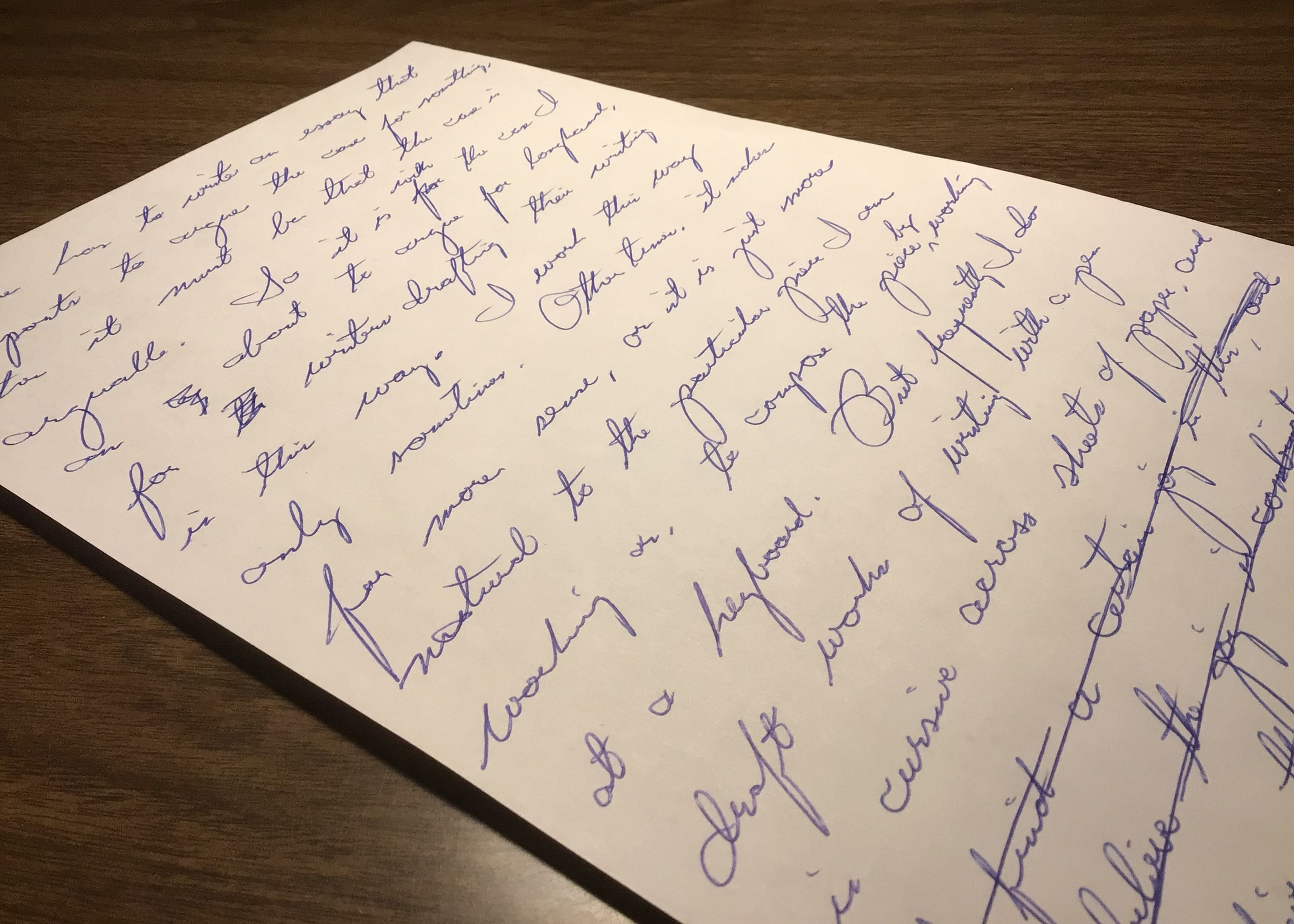
If an essay must be written to argue the case for something, then it must be that the case is arguable. So it is with longhand writing, and the case I am about to make for writers drafting their work this way. I work this way only sometimes. Other times, it makes far more sense—or it is just more natural to the piece I am working on—to compose the text through a keyboard.
Yet frequently I do draft works of writing with a pen in cursive across sheets of paper, and there is a reason, a purpose for writing this way.
The case would not have had to be made in the past, of course. In an earlier time, there was hardly a more practical option. Live long enough, and you get to see formerly unremarkable practices become strange enough to be remarked upon. At the office where I work, I was recently called out two times in quick succession by two different coworkers in different encounters who both noted with surprise (or alarm) that I had produced cursive text. It happened once was when I was seen keyboarding a piece from a draft I had written in longhand, then again when I arrived to a meeting with my own discussion points written on a pad while everyone else was there with open laptops. The reactions led me to examine: Why not surrender completely to keyboard composition? Why resist? My PC and the directories connected to it can receive, store, and organize every list, thought, idea, and document I might ever want to compose. When I set the keyboard aside in favor of writing the analog way, why do I do this?
I find it is not a hard question to answer. Why cursive, why longhand, why analog writing with paper and a pen? The reasons include all the following:
1. The effort producing restraint
The physical work of making cursive by hand slows down my writing, and this is good. The effort of dragging a pen across the paper means I must calculate the value of each sentence I draft. Is this next line worth the physical effort? For me, keyboarding is so much easier than cursive that it is often too easy. Excessive writing, elaboration that does not help the piece, spills upon the screen because the cost is so much less. The work of handwriting, and the calculation of this work, produce concise drafts that serve the reader more efficiently than the drafts I produce by keying.
2. The hum I think I can hear
Writing with pen and paper is quiet. Writing with an electronic device might be similarly quiet in terms of measurable sound, but the same sense of quiet is missing. I know the device is running. I know there is activity happening to keep the device active and ready: current is coursing, electrons are moving. As a result, there is a hum I think I can hear whether I can hear a hum or not. My thinking therefore feels clocked, and taxed, because a device has to remain active all the while I am passive in thought. (A retort: But the lights remain on! When you are writing by hand, current courses through the lights. My answer: True enough. On occasion, I carry the sensitivity to that very conclusion—turning out the lights if I feel it will take a lot of thought to work through a particular passage.)
3. The luxuriousness of less
The feel of minimalism is a joy. Writing offers this, and we who are called to this work should relish this benefit of the call. Writing is an art requiring little, and longhand writing makes the requirement almost nothing: just an implement, just a page. I have learned how fortunate I am for this gift. The one who loves dance can only practice her art with a stage or studio spacious enough for leaping. The one who loves equestrian arts can only practice them with a horse. A person is blessed who loves a craft that is so uncostly.
4. The echo of authors past
The feeling of connection to writers in other centuries can be soulful and close. This pausing over the page, this movement of the pen—they all did the same.
5. An enjoyment of the effect
Cursive is sensual. I feel a loss for the writer with no sense of this pleasure—the glide of ink, the give and acceptance of the pillow of pages beneath the point of the pen. There is a lush physicality to this practice of the craft.
6. The authority over space
Writing on a page offers a dimensional freedom in organizing thought that keyboarding still offers no good way to replicate. As I draft in longhand, any idea needing notation or elaboration can be given this support using any open space on the page. Notes on the page far away from the passage they qualify can be annexed to the affected text by drawing an arrow. A page from a cursive draft might therefore have various arrows and various circles, along with lines of stray text along an axis separate from the rest of the work. And it all makes sense; the annotations and revisions are all intuitively clear at a glance in a way that a set of click-to-open digital annotations is not. The page of cursive composition is, in a way, a canvas for ideation.
7. My life and heritage
Along with all of this, let me not discount the personal fact that this is how I learned to write. Because of the timing of when I entered the world, I was instructed and expected to write by hand. We are to be whom we are to be. This is in part a product of our choices, and to just as great an extent, it is a product of what we were given. We face and correct whatever we were given that is deficient or harmful, but this is not that. Writing by hand is something I was given as part of a time, as part of an age, and I accept the gift.
8. The experience of peace
The peace I find in cursive writing has a practical secondary effect I sometimes seek. In the quiet, contemplative state of writing upon a stack of pages or a pad, other solutions to other problems apart from the writing sometimes present themselves. To be sure, this is partly a benefit of the physicality of the writing, how movement aids thinking. I think it is also the effect of something more. There is a positive flow that comes my mind and its attention being directed to work, and to a means of carrying out that work, that they were seemingly made to do.