
In modern times, in our complex contemporary society, generally there are two big objections to seeing God at work in the world and in our lives, and seeing Jesus Christ as the Savior and the incarnation of this God. Those two objections are, in essence: I am too busy, with too much going on to give time and attention to this abstraction; and/or I am too advanced in my thinking to give unreserved acceptance to such a widespread, unchanging belief, including tenets that have become too simple alongside our advanced sophistication.
The first objection, “I am too busy,” is shorthand for the way the practical concerns of doing our jobs, managing our families, paying our bills, and enjoying our recreations are immediate, urgent, and loom so large they fill all our capacities. Exploring or practicing faith in the One who created all these contexts and concerns is, by comparison, seen as impractical.
The other objection, “I am too advanced,” while not necessarily a position of atheism, constitutes a sort of operational atheism in which any question about God and Christ either has been or cannot be addressed, allowing the one with this position to operate above the entire matter. According to this view, people have been talking about God and the accounts of the Christian gospels for a long time now, including people from long ago who knew less that we know now. Today, we have professionals who deal with the idea of God—theologians and clergy on the one hand, skeptics and detractors on the other—and simply being familiar with the positions of both camps demonstrates I am as conversant in the matter as it is reasonable to be.
I describe these as the views of “modern times.” But modern times go way back. In the complexities of their lives and in the habits of their thought, the first-century subjects of the Roman Empire are nearer to us in the twenty-first century than they are to most humans in most societies that preceded them. The bible’s New Testament, a collection of reports and correspondence about Jesus, was written to these Romans: cosmopolitan people who felt their busyness and sophistication much like we do.
One such person appearing in the New Testament is Simon Peter, the owner of a fishing business who became a close companion of Jesus. In one famous scene, Peter suddenly turns a corner in his thinking and comes to recognize Jesus for who he really is, the so-called Messiah, the Son of the living God, the incarnation of God here on earth.
Except … I have been reading and rereading the part of scripture in which this insight comes. I am coming to recognize that perhaps this realization was not so sudden.
It was sudden for Peter. The moment arrives in Matthew’s gospel, chapter 16. Jesus asks Peter, “Who do you say I am?” I hear Peter surprising himself in his answer. He says, “You are the Messiah, the Son of the living God!” (Matthew 16:16).
Yet within this same chapter, we see how Jesus cleared the way for this insight by removing obstacles in its path.
Within the chapter, seemingly as preparation and prelude to what Peter came to see, Jesus speaks about how busy and advanced we are, addressing modern people about their modern concerns.
Objection #1: I Am Too Busy with My Life to Care Whether Jesus Is God
In an encounter prior to his direct question to Peter, Jesus told his disciples to beware of the yeast of the Pharisees and Sadducees. The meaning seems plain enough: Don’t let the teaching of these religious authorities get into the bread of your faith. But the disciples could not see the spiritual implication. They had minds only for tangible bread, of which the Lord had already demonstrated that he is the abundant provider….
The disciples reached the other shore, and they had forgotten to take bread.
Then Jesus told them, “Watch out and beware of the yeast of the Pharisees and Sadducees.”
And they discussed among themselves, “We didn’t bring any bread.”
Aware of this, Jesus said, “You of little faith! Why are you discussing among yourselves that you do not have bread? Don’t you understand yet? Don’t you remember the five loaves for the 5,000 and how many baskets you collected? Or the seven loaves for the 4,000 and how many large baskets you collected? Why is it you don’t understand that when I told you, ‘Beware of the yeast of the Pharisees and Sadducees,’ it wasn’t about bread?” Then they understood that he did not tell them to beware of the yeast in bread, but of the teaching of the Pharisees and Sadducees. —Matthew 16:5-12
To give the disciples their due, they were facing an urgent problem. They had crossed the Sea of Galilee without bringing food, so they were beginning to wonder when and how they would eat. However, urgency is fungible. If this problem had been solved with baskets of food, then the disciples’ inclination to focus on a material problem would find some other perceived need to worry about.
More significantly, this very problem had already been solved with baskets of food. It had happened just recently, in Matthew chapter 15. Jesus fed thousands of people who had come to see him, demonstrating that he is the Lord, and the Lord is the provider, by taking seven loaves and a few fish and turning them into enough food to feed everyone present. As Jesus makes clear, his having done this once—as he mentions, he actually did it two times—means he could do it again.
The miracles of multiplying loaves and fishes make explicit something that can otherwise be overlooked for its implicitness. Namely, God is the provider. We are to move through the world he made and be faithful in the work he puts before us, yet it is the Creator who created our ability to do so and it is even the Creator who determines the outcome. The proper use of the mind therefore is not to fill it with thoughts of these material provisions, but to give attention to the will and wonder of the Provider.
The disciples understood, says the final line of the passage above. They heard and comprehended that the talk about bread pointed to something more than bread. There are our needs and wants, which can fill our attention if we let them. But there is also a created world, made by a Creator who is active in that world, and the busyness of pure absorption in our physical aims leaves us unable to understand what the Creator is giving and sharing.
The disciples at last understood, says the passage. Peter, one of their number, understood.
Objection #2: I Am Too Advanced to Believe Jesus Is God
Or, expressed more bluntly: I am too smart to believe Jesus is God. While simple people find comfort in this claim, I am more sophisticated and need something more.
The Pharisees and Sadducees, the institutional religious leaders and theological authorities of the time, were sophisticated and needed something more. In Matthew 16:1, we see them asking Jesus to offer a sign that would validate to their satisfaction that they should accept him as the Messiah, as speaking and acting with the authority of God.
Jesus refused to comply. That is, he refused to prove himself on the terms of the sophisticated, because those terms are a lie. Sophistication can be a cover over willful ignorance. Once a person becomes too proud to accept what others see, he or she can never be moved by evidence, because the self-satisfied sense of sophistication will always look for a still more complex argument that only the presumably advanced mind can see. The one who is smart can talk oneself into most any position.
In the full passage, Jesus answers them by mentioning a very different sign:
The Pharisees and Sadducees approached, and as a test, asked him to show them a sign from heaven.
He answered them: “When evening comes you say, ‘It will be good weather because the sky is red.’ And in the morning, ‘Today will be stormy because the sky is red and threatening.’ You know how to read the appearance of the sky, but you can’t read the signs of the times. An evil and adulterous generation demands a sign, but no sign will be given to it except the sign of Jonah.” Then he left them and went away. —Matthew 16:1-4
Jonah, the biblical prophet about whom all the listeners would have known, was famously inside the belly of a fish for three days before leaving the fish and returning to life. This was the sign foretelling how Jesus’ divinity will be demonstrated. In other words, in addition to offering plenty of signs that could be seen and read as plainly as the sky, Jesus was also about to manifest and live out the meaning of one of the most powerful signs recorded in scripture.
Rather than accommodating the false skeptics, rather than submitting to their disingenuous conditions and terms, Jesus “left them and went away.” And the very next verse (the beginning of the “yeast” passage quoted earlier) makes clear that Peter came with him.
All This Was Said to Peter
Let’s come back now to Simon Peter. An odd detail of Jesus’ response to the Pharisees and Sadducees connects to an added detail of Jesus’ later response to Peter.
To the religious leaders, Jesus might have said, “No additional sign will be given to you.” Instead, he gave a qualification: No sign will be given except the sign of Jonah. Why this allusion?
Then, to Simon Peter, in the moment Peter has his breakthrough and puts it together that Jesus is the Messiah, Jesus does not say just, “You are blessed.” More particularly, he says, “Simon son of Jonah, you are blessed…” (emphasis mine). Why bring in the name of Peter’s dad, a detail that gospel readers have not encountered until now?
Jesus is hinting, I believe, at whom he was thinking about all the way through, and a double meaning captures this hint. Peter is the son of a man named Jonah as a fact of parentage. Meanwhile, Peter is also the “son” of the sign of Jonah pointing to Jesus—in that Peter understands the truth, and has looked up out of the context of sophistication and busyness to declare it.
Matthew chapter 16 could thus be seen as the story of Jesus working on the mind of Peter, getting Peter clear of the obstacles of presumption impeding the Spirit’s advance.
Various points emerge from this:
1. Jesus’ teaching to the crowds is not necessarily about the crowds. Jesus himself telegraphs this point, saying in another context, “He who has ears to hear, let him hear” (Mark 4:9). His teaching is instead to the one who might hear from within the crowd, as a witness or bystander to the crowd like Peter, or (perhaps also like Peter) to the one who needed the crowd and its reaction as part of the context of his hearing. The success of preaching is not in numbers but in the person who is moved.
2. Peter’s revelation, which was given to him by the Father (made clear by Jesus himself in Matthew 16:17), nevertheless also required counsel and teaching to find clarity and form. Peter was not given a disembodied message, but rather, he was given understanding of the fullness and implication of what he had been taught. The Holy Spirit uses teachers, and they must teach.
3. Jesus did not aim to make his main appeal through the masses. Instead, Jesus’ attention was ever on the small group of his disciples, who for a time were the only people continuing with him after others had turned away (John 6:66-68). This is the positive principle standing with the principle expressed as a negative in point 1: Not only is the success of preaching and discipleship not in numbers, but it specifically leverages small numbers. Only through close contact could Jesus impart his Way, and his attention was on the small numbers he could reach and move even as he went off to address the large crowds.
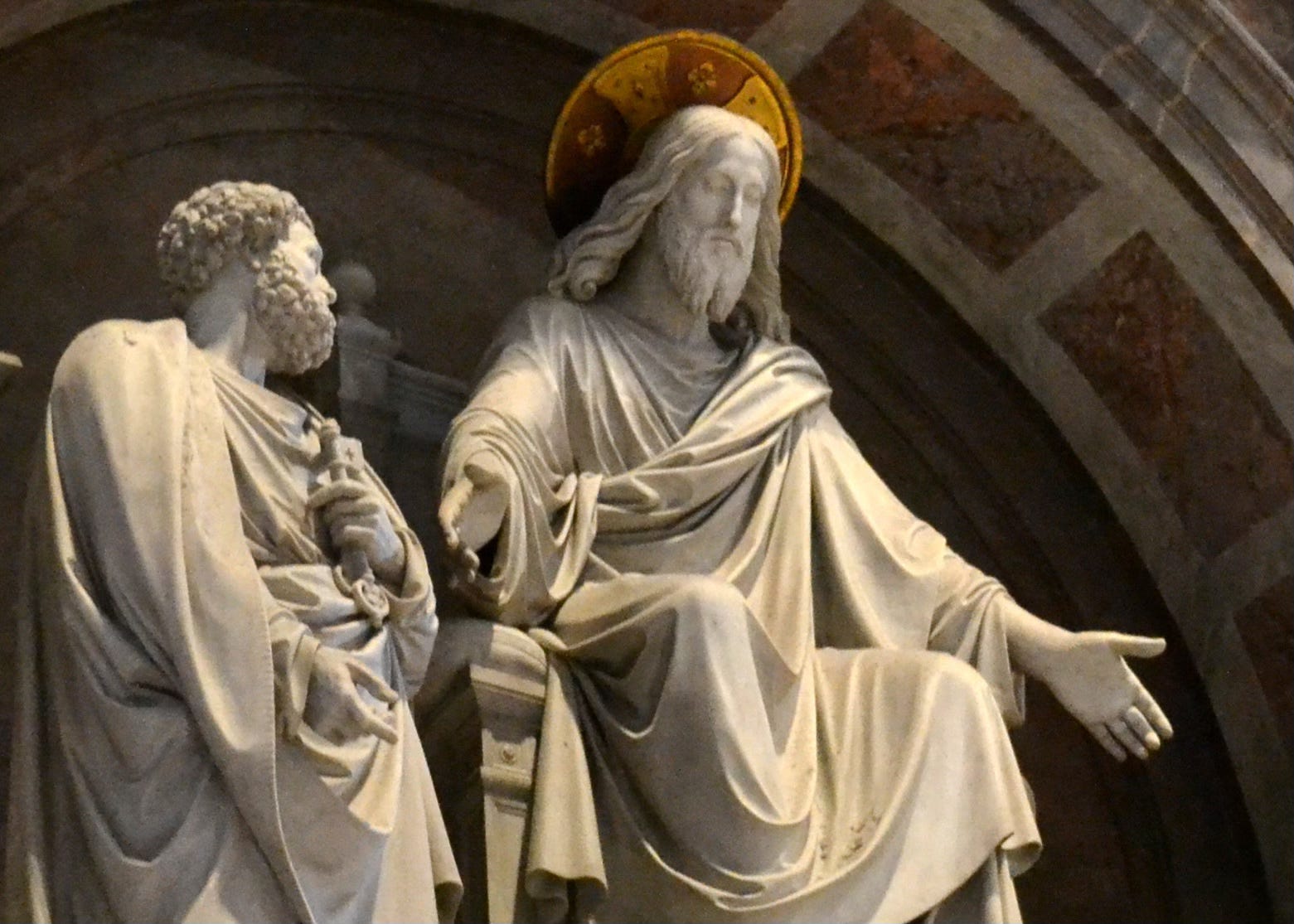
Photo: “St. Peter’s Basilica,” detail showing Peter and Jesus, by Larry Koester