
Jesus in chapter 18 of Matthew’s gospel offers a clear requirement and precondition for being part of God’s kingdom. He says:
“I assure you ... unless you are converted and become like children, you will never enter the kingdom of heaven. Therefore, whoever humbles himself like this child—this one is the greatest in the kingdom of heaven.” —Matthew 18:3-4
What does this mean?
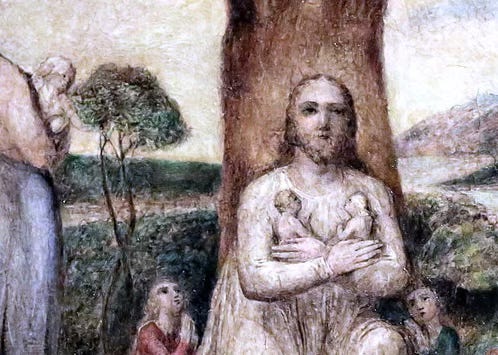
Jesus is presumably speaking of small children. In ancient times, older children would be regarded as nearer to adults, and when Jesus returns to the theme later in the chapter, he speaks of little children explicitly. (See my reflection on Matthew 18:10 and its hints about purpose and angels.) If being like these children is somehow vital to being a part of the divine kingdom, then what are little children like?
There is an easy danger here of idealizing children, regarding them as sweet, trusting, guileless, innocent, pure. They are all this, but more as well.
I was recently in the company of two parents overseeing their preschool-age child. I am a parent, too, meaning I have lived through this season of my own children’s lives. Yet even for me now, it is possible to idealize. What are little children really like? Let me tell you.
Answer: They cry out. If they perceive a need, they make it known. This is true if the child lacks the words but perceives only the feeling. Children know want and they know pain and fear, and they cry out with the expectation that this feeling will be answered. Children are trusting, yes, and an aspect of their trust is the way agony is unguardedly expressed to the parent.
What are children like? Another answer: They have a way of frustratingly failing to speak in the language of our broken values. How many parents, not to mention adults associated with parents, have had the experience of giving the child what we feel ought to be a tantalizing gift, only to have it completely unappreciated? This is the case of a stick lying on the ground proving more interesting than an exotic toy. We try to satisfy children with objects or distraction, when what is really interesting to the child, what the child really wants, is to flourish and grow under the attention of the parent. Our children love us to an extent that shames us because we do not love ourselves the same way. This love is nearer to the center of their experience than any treasure or trapping we might give them. The child lucky enough to have a family feels and knows a belonging to this family, and will run to the family if separated, easily preferring the family’s hovel to an opulent mansion. To this extent, the child’s value system is better than the parents’, because if there was a way to get a mansion in place of a hovel by rejecting or abandoning another, it is we parents who might find a way to do this.
So: To come to the kingdom of heaven is to recapture some of this way, the way of the small child, even by watching the child to relearn what we have forgotten. To “humble himself like this child” is to take the way a child regards his or her earthly parent and translate this toward the heavenly Father who has made us brothers and sisters to his Son.
What then is the little child like? More than sweetness, more than guilelessness. The model of little children we can see suggests at least this much more:
A child of the kingdom of heaven expects care. There is a vocal and unguarded trust that care will be provided, including needs fulfilled and comfort in time of distress.
A child of the kingdom of heaven offers unquestioning acceptance of the place and position in which he or she is placed. The house where she lives; the family to which he belongs. A child of the kingdom of heaven of course moves through the world as a grownup, aspires to improvement, and seeks to fix what is missing. But the child of heaven does not pine after circumstances except those in which God has given the child a place.
A child of the kingdom of heaven loves the Parent. Easily, predominantly, unquestioningly. Feels rewarded by the chance to be with her Parent and loves this experience for its own sake. A child of the kingdom of heaven knows she has this relationship with God and comes alive within this childhood.
Photo: Detail from “IMG_1832B William Blake. 1757-1827. Londres. Christ bénissant les petits enfants. Christ Blessing the Little Children. 1799. Londres Tate Britain.” By Jean Louis Mazieres.