
Jesus said to take up one’s cross and follow him. This is how he described the condition and the experience of being with him and remaining in his presence. He said it this way:
Then Jesus said to his disciples, “If anyone wants to come with me, he must deny himself, take up his cross, and follow me.” —Matthew 16:24
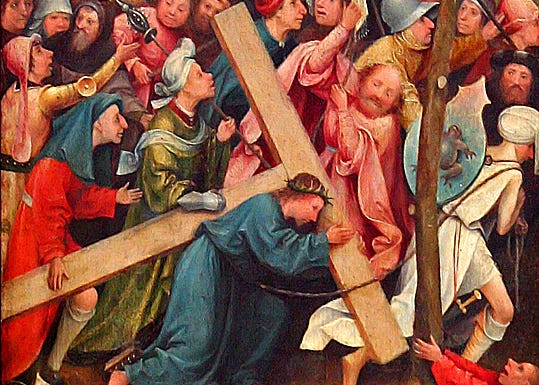
At least two simple questions arise from this plain-spoken statement by Jesus. One is: What is a cross? The reference is clearly, to some extent, an analogy. For Jesus, the “cross” was a literal cross. It was placed upon him, he was made to carry it, he bore it through the crowd, he went with it to his execution spot, then he suffered and died on it. And others after him who died as martyrs were crucified as well. But for you and me, no one is presenting us with a literal cross.
What is a cross, then, in this statement?
A reasonable answer: It is the analogy that fits. The cross for you or me is the circumstance or affliction that has many of the same attributes as a physical cross.
That is, it is a burden to carry that is also the means of one’s suffering.
More, it is assigned to the bearer. Your cross is the thing you carry that is seemingly yours alone, that separates you from the crowd around you because none of them are carrying the same burden.
Taking the inquiry further, what does it mean to follow?
This is the other simple question arising from Jesus’ statement. Again, the answer must in part be analogy. We do not have Jesus before us as a man with physical footsteps, walking ahead to lead the way. In the absence of this, what is the nature of following?
The answer connects to the cross, because Jesus’ statement connects them. His call to follow is to one who has shouldered the cross. The way to follow is therefore to proceed as Jesus did after he took up his (literal) cross.
How did he proceed? Where did he go?
Answer: He went through the suffering. He went through it to the other side.
Of course, there is an alternative to all of this. The alternative is to not take up the cross. That is, to resist it, reject it, perhaps even become angry about it. To demand that I and mine should not be singled out in this way, should not have a burden that is so separate and different from the crowd around us.
Is there any possibility to follow Jesus and be with him in the absence of a cross to bear?
Suffering is not needful, let alone deserved. Many things we want to get better do get better. We experience relief and resolution of pain, problems, and difficult situations routinely in the course of a life full of God’s gifts, and we ought to seek and pray for these things. Happiness cannot be owned, but we can borrow it again and again.
Yet then there is the cross, the burden all our own that we find ourselves called to bear.
It is the nature of this burden that it must be different. It is the nature of the suffering it entails that this is distinct—seemingly less than the suffering of many others, while also a type of suffering of which many are ignorant and completely spared. The particular cross laid upon me, which others do not carry, is therefore not a sign of defect or failing. It is instead inevitably what the way of following must look like.
We are created selves. Created individuals, unique. Each of us is uniquely loved and called as such. The burden, affliction, or problem that is recognizable and equivalent to everyone else’s suffering is, in a sense, not a burden at all. To hold back and insist on not being singled out, including not being singled out in suffering, is to not live an individual brave life, and therefore to not follow—not live the fullness of how we are made and who we are made to be. Saying yes to life means saying yes to individual lives, including one’s own, because this is the form life takes.
The assurance (and reassurance) is found in the plain-spoken statement: Carrying is the way of following. Carrying a cross is how following Jesus goes.
The cross is figurative—yours is different from mine. Each of our burdens is different. It is in the following where we start to converge, heading toward the same destination.
Jesus showed the whole way through. The other side of suffering is the point where the crosses come together, the point where the figurative and physical become one. The other side is the point at which all the talk and all the signs about life after suffering are revealed to refer to life after all—real life, physical life, non-figurative life, rising again.
Photo: Hieronymus Bosch, “Christ Carrying the Cross” (detail), photographed by Frans Vandewalle